
We often believe that our home belongs to us exclusively. However, as soon as the door closes behind us for several months, an unexpected world quietly takes over. The local wildlife quickly detects our comfortable spaces as ideal refuges to protect their offspring from predators.
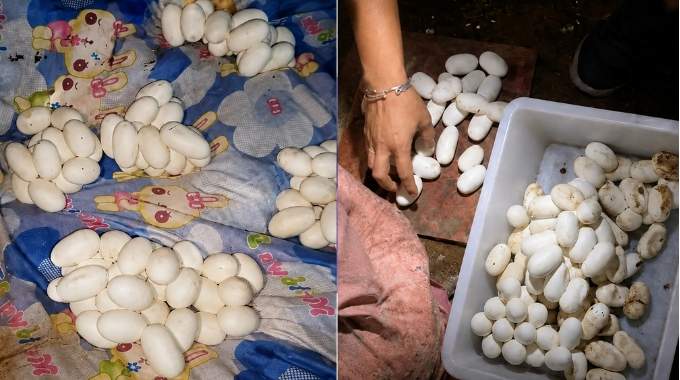
This was the unfortunate lesson learned by a man who recently discovered more than a hundred mysterious eggs covering his bed after a six-month absence.
Summary of the Situation
An unoccupied house becomes a true magnet for animals: The silence and consistent warmth attract species seeking a safe place to lay their eggs.
Beware of appearances: Finding over a hundred eggs is usually not the work of a single reptile but often the result of a communal nest or even eggs from insects or spiders.
Avoid any handling: Touching these eggs can endanger the embryos’ life. It is crucial to isolate the area and call in wildlife experts.
When Your Home Turns into a Natural Refuge

Leaving a house empty for several months is somewhat like offering a five-star hotel to the surrounding animals. In nature, these creatures are always searching for secure places to protect themselves from predators, climatic changes, and harsh weather. A closed home provides an ideal microclimate: no human activity, complete silence, and residual warmth that is greatly appreciated.
Wild animals show remarkable ingenuity when it comes to infiltrating your home: a crack in the foundation, a worn window seal, a poorly closed pet door, or just a few millimeters under the front door are often enough. Once inside, the calm environment offers them the perfect setting to settle. Your bedroom, with its soft mattress and insulating blankets, becomes an ideal refuge for a female searching for a secure nesting site.
Over 100 Eggs: The Biological Reality Behind the Discovery

It is important to take a step back from the sensational reports often circulated on social media and better understand the facts. Finding one hundred eggs on a bed raises a legitimate scientific question: typically, small common lizards or snakes that can enter a house lay rarely more than a dozen eggs at a time.
To explain such a large number, several biological hypotheses are possible:
It could be a communal nest. Some species, such as certain grass snakes, share their nesting sites. Multiple females lay their eggs in the same place if the humidity conditions are optimal.
Another frequently overlooked possibility is that these eggs do not necessarily come from reptiles. Many insects, and even some species of spiders, lay hundreds of eggs grouped together in cocoons that resemble small white spheres, often mistaken for reptile eggs.
This highlights how misleading a viral photo can be without rigorous analysis conducted by an expert.
The Delicate Identification and Mistakes to Avoid

If you encounter such a discovery, your first instinct might be to inspect the eggs more closely. However, distinguishing a reptile clutch from that of amphibians or insects can be a complex task for a novice. Snake or lizard eggs lack a hard shell like bird eggs. Their texture is often soft, resembling leather, with a slight pearly sheen.
The golden rule is to never handle these eggs. Unlike bird eggs, which must be frequently turned by the mother, a reptile embryo quickly attaches itself to the upper inner membrane of the egg. Turning the egg, even slightly, could cause the embryo to drown in its own amniotic fluid, leading to its death.
Additionally, many wild species are protected by law. Destroying or moving a nest without permission can result in legal penalties.
Actions to Take for Safe Management of Egg Presence

When confronted with a nest discovered on your bed, panic should not take over. Here are the essential steps:
Ensure safety by immediately keeping children and pets away. They might destroy the nest out of curiosity or get stung if the mother is still nearby. Close the door to confine the space.
Contact professionals promptly: a wildlife rescue center, a veterinarian specialized in exotic pets, or local environmental services. These experts have the appropriate equipment and knowledge to accurately identify the species, assess any potential danger, and relocate the clutch to a natural habitat without harming the future offspring.
Preventing Animal Settling During Long Absences
Fortunately, you can avoid such surprises by preparing your house before a long trip.
Thoroughly inspect your home a few days before leaving: seal all cracks, check ventilation grilles, and ensure window seals are tight.
The most effective method is to simulate occupancy. Ask a trustworthy neighbor or relative to visit regularly to air the house, run some water, and create noise. This disrupts the absolute silence that some animals seek.
Nowadays, installing connected cameras or motion sensors remains a good way to detect the early presence of an intruder from wildlife.

In this article, we present the six main mistakes to avoid in order to preserve your refrigerator and ensure its Read more

Most of us believe we understand baking soda well. It rests quietly in a kitchen cupboard, freshens the refrigerator, rescues Read more

An Ingenious Mechanism for Transporting Bottles In an era when safely transporting wine was a true challenge, rough roads and Read more

Understanding, anticipating, and supporting your dog through every stage of their life is essential to providing them with the best Read more
After discovering the surprising effects Vicks VapoRub can have on your body, you'll be amazed—and I assure you that from Read more
There was a time when going out without high heels was almost unimaginable. In the 1950s, 60s, and even the Read more
When I first spotted a peculiar red, slimy form in my garden, my initial thought was that I had stumbled Read more
Some people purchase walnuts that are already shelled, while others prefer to buy them in their natural state, still in Read more
As the leaves fall and temperatures drop, many of us seek the cozy warmth of a heated home. However, we Read more
For centuries, Chelidonium majus, commonly known as Greater Celandine, has held a special place in traditional herbal medicine. Recognized by Read more

Dented Car Body: How to Fix It Yourself Over time, the body of your car can endure a lot. From Read more

Skin Changes After Age 65 As we age, our skin undergoes natural changes. The epidermis thins and becomes more fragile. Read more
We thought they had been eradicated, yet bed bugs are making a strong comeback. These tiny, nearly invisible creatures have Read more

Thyme is known by some as the "enemy of toxins," a reputation that dates back to stories from ancient Greece. Read more

Thyme is known by some as the “enemy of toxins,” and it has been part of stories since ancient Greece. Read more

Shepherd’s Purse (Capsella bursa-pastoris): A Medicinal Herb with Powerful Benefits Shepherd’s Purse, known botanically as Capsella bursa-pastoris, is a small, Read more

Using a power strip to plug in multiple devices is convenient, practical, and budget-friendly. However, this widespread practice carries significant Read more

When you sink your teeth into a soft, caramel-sweet date, the last thing on your mind is usually the tough Read more
Main Causes of White Spots on Nails The small white spots sometimes seen on nails are scientifically known as "leukonychia." Read more

Tomatoes, a staple in kitchens worldwide, are loved for their versatility and rich flavor. However, their perishable nature often leads Read more

Weasels, although often regarded as charming animals, can quickly become a genuine source of nuisance. These small, solitary, and nocturnal Read more
The Symbolic Significance of Slugs Inside the Home Since ancient times, various cultures have assigned deep symbolic meanings to slugs. Read more
The Brown Recluse Spider: A Small Spider with a Violin-Shaped Mark on Its Body Imagine a tiny spider, modestly brown Read more

Much More Than Just a Decorative Element The presence of multiple pillows on a hotel bed is far more than Read more

Creating a fresh and inviting atmosphere in your kitchen doesn't require expensive air fresheners or synthetic scents. With just a Read more

Corn silk, the delicate, hair-like strands that grow on an ear of corn, has a long history of use in Read more

In the realm of gardening, we often stick to traditional methods like basking in sunlight, diligent watering, and soil enriched Read more

This image does more than just trick our eyes; it also reveals a lot about our personality. Depending on what Read more

Embroideries and Refined Details: Don't Throw Away Your Textile Treasures Some old towels hold true treasures: hand-embroidered initials, delicate lace, Read more

Why Does the Plastic of a Washing Machine Yellow Over Time? Over the years, it is common to notice that Read more

Highland flowers, often found in remote, elevated regions, are more than just a visual delight. These resilient blooms, thriving in Read more

Datura stramonium, commonly known as Jimson weed, thorn apple, or devil's trumpet, is a plant native to North America but Read more

The Importance of Securing Your Hotel Room When traveling, people often focus on the comfort of the bed or the Read more
You have probably come across an intriguing object whose purpose completely eluded you. Whether it was a discovery in a Read more

In today's digital age, it's a common sight in households and offices: chargers left in outlets without their corresponding devices. Read more

8 Surprising Benefits of Water Cloves You Probably Didn’t Know About Cloves are widely recognized for their warm, spicy aroma Read more
What Is the Metal Terminal of an Electrical Outlet? The metal terminal, often referred to as the ground terminal, is Read more
Imagine the scene: you are casually scrolling through your news feed when suddenly, an image grabs your attention and stops Read more

What Does the Presence of a Red Spot in an Egg Mean? Contrary to popular belief, this red spot is Read more
Imagine preparing a simple meal for your loved ones, only to discover that your chicken breast falls apart into long, Read more
